
Social & Emotional Skills Program | 8–12 Years
Secret Agent Society® Small Group Program (SAS-SG)
Turning Social & Emotional Learning Into a Mission
Some children are incredibly bright, curious and capable — yet friendships, emotions and everyday social situations can feel much harder than they appear from the outside.
They may struggle to work out what someone else is thinking or feeling, become overwhelmed when things do not go to plan, react strongly to frustration, or find it difficult to know what to do when friendship problems arise. And for some children, simply talking about these challenges is not enough.
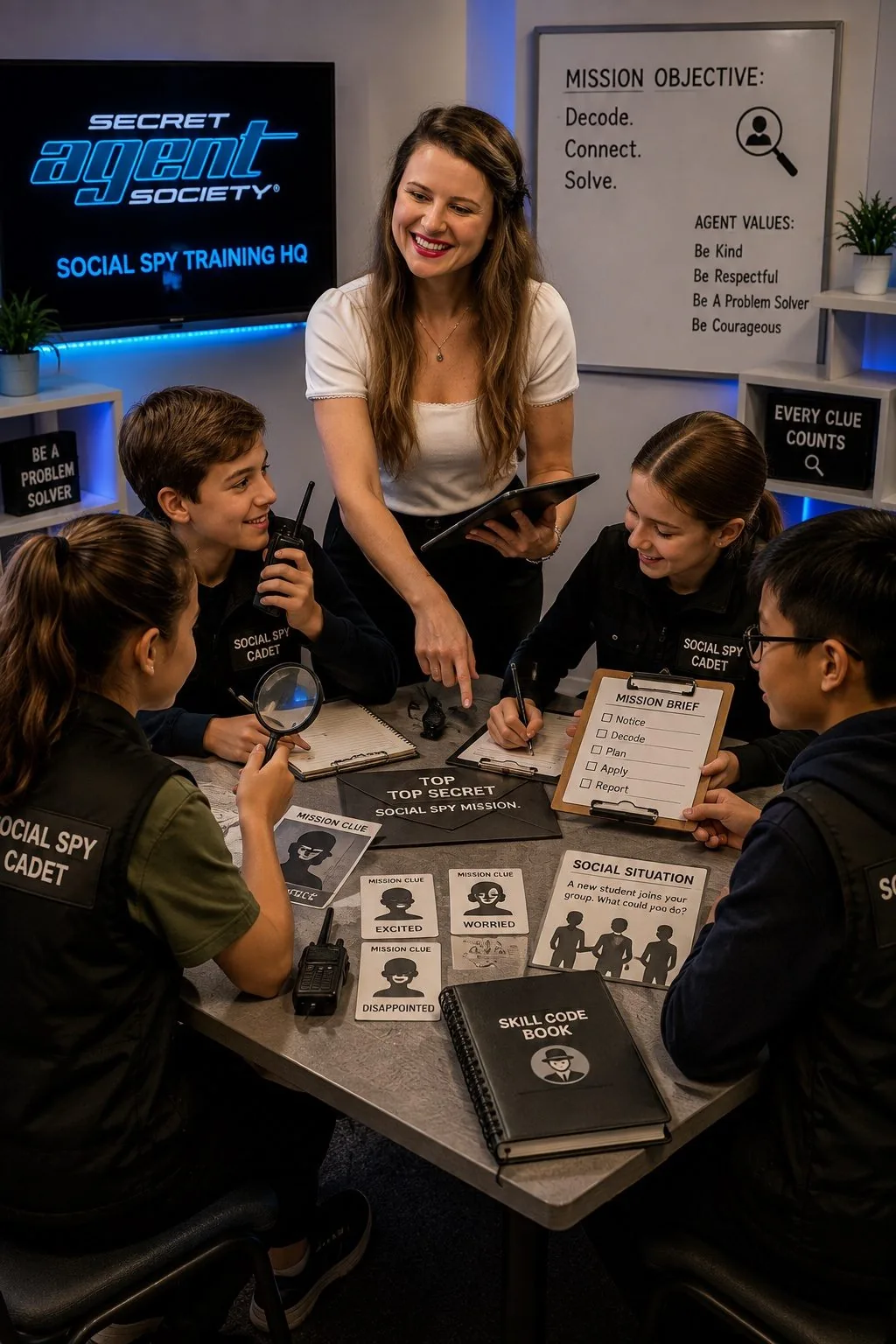
This is why our clinicians trained in Secret Agent Society® Small Group Program (SAS-SG) — a structured, evidence-based social-emotional skills program that transforms learning into an engaging secret-agent mission. Rather than expecting children to simply “pick up” social and emotional skills, SAS explicitly teaches them through spy-themed activities, games, codes, gadgets, role-play and real-world practice missions.
Children begin as Cadets and work towards becoming Secret Agents while developing practical strategies they can use across friendships, emotions, school and everyday life.
- Gamified Learning
- Social & Emotional Skills
- Real-World Practice
- Parent & School Support
About the Program
Social & Emotional Skills — With a Secret Agent Twist
Children enter Secret Agent Society® as Cadets and take part in structured Club Meetings led by trained SAS facilitators. The secret-agent theme isn’t simply decorative — it’s used to make explicit social-emotional teaching engaging, memorable and practical, particularly for children who may switch off when learning relies on conversation alone.
Sessions combine codes and tools, interactive activities, role-play and behavioural rehearsal, games, and practice missions that carry the learning into home and school.
The program focuses on four broad skill areas: emotion recognition, emotion regulation, social problem solving, and social skills — explored below.
Program Suitability
Could Secret Agent Society® Small Group Program (SAS-SG) Be a Good Fit for Your Child?
SAS may be considered for children who would benefit from structured and engaging support to understand emotions, navigate social situations and practise practical strategies for everyday life.
Difficulty recognising or understanding emotions
Big emotional reactions, frustration or anxiety
Difficulty calming once upset
Friendship difficulties
Trouble understanding social cues or perspectives
Difficulty solving social problems
Challenges coping with change or unexpected situations
Difficulty navigating teasing, bullying or peer conflict
Knowing social rules but struggling to apply them in the moment
Wanting practical strategies rather than discussion alone
Children do not need to experience difficulty in every area. Suitability is considered individually, taking into account the child’s strengths, needs, goals, developmental profile and whether the current group is likely to provide an appropriate learning environment.
Cadet Training
The Four Core SAS Skill Areas
Emotion Recognition
Noticing emotional clues
Recognising emotions in themselves and others
Considering facial expression, body language and context
Developing emotional vocabulary and awareness
Emotion Regulation
Recognising escalating emotions
Strategies for anxiety and anger
Identifying helpful regulation tools
Practising ways to respond when emotions become intense
Social Problem Solving
Identifying social problems
Considering possible responses
Predicting potential consequences
Practising flexible problem-solving
Social Skills
Friendship skills
Teamwork
Conversation and interaction
Navigating peer situations
Responding to common social challenges
How It Works
Learn. Decode. Practise. Apply.
- 01
Learn
Cadets are introduced to explicit social-emotional strategies through structured teaching, SAS activities and digital activities in the SAS portal during sessions.
- 02
Decode
Children learn to notice clues in emotions and social situations and explore different ways of responding.
- 03
Rehearse
Skills are practised through games, role-play, behavioural rehearsal and supported activities.
- 04
Complete Missions
Children continue through the SAS computer game at home and complete between-session missions, practising relevant skills in everyday environments including home, school and social situations.
Parent & School Involvement
Building Skills Beyond the Club Meeting
SAS doesn’t treat the child in isolation. Following each child group, parents and carers attend their own session to go through the content covered and discuss how their child is progressing.
With consent, classroom teachers are also contacted and given guidance on how to support the child through the program. Teachers are added to the SAS portal so they can check in with the child at school and see how the strategies are being used there, and they receive weekly tip sheets outlining the content covered in each session. Teachers can also award points that count towards the child’s reward system at home, so noticing a skill being used at school actually registers somewhere for the child.
The goal is not for adults to constantly correct the child. It is to create informed adults around the child who understand the same strategies and can support practice across home, school and the group.

Teacher Involvement
The Teacher Role Is Built Into the Program
Most programs ask a school for a room. SAS asks for something more useful and gives the school something back: classroom teachers are briefed at the start, added to the SAS portal, sent weekly tip sheets so they know what was covered, and able to award points that feed the child’s reward system at home. The teacher’s job is to notice and encourage — not to deliver the program or monitor behaviour.
Looking for Secret Agent Society® for your school? The school page sets out how it runs in a school — timetabling, the play period, teacher briefing and portal access, and how the parent meeting is planned.
Why SAS?
More Than Talking About Social Skills
SAS combines explicit teaching with gamified learning, behavioural rehearsal, practice missions and support from the adults around the child.
Structured & Explicit
Complex emotional and social concepts are broken into practical strategies.
Learning Through Games & Missions
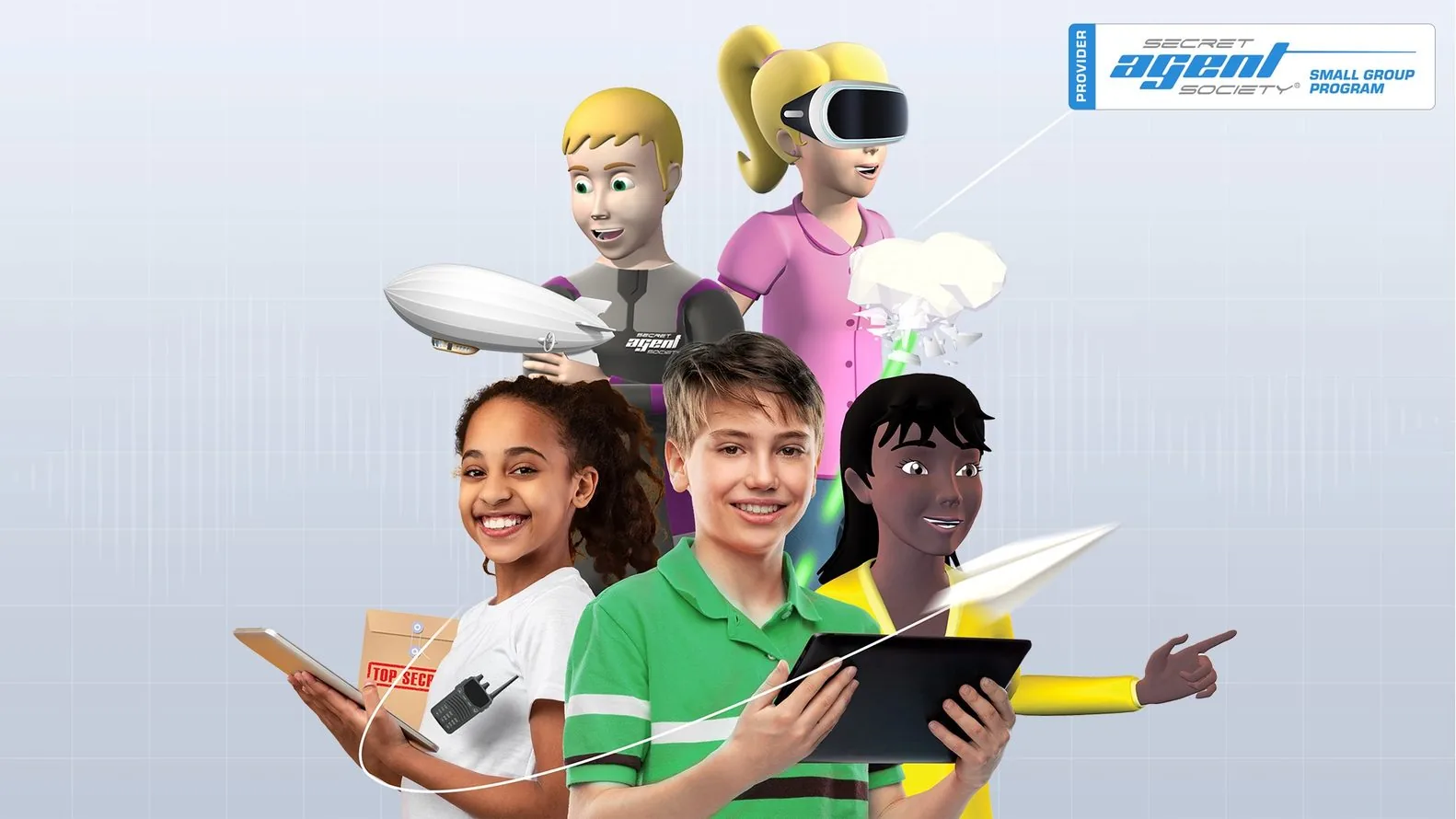
The secret-agent framework runs through the whole program. Its characters appear across session content, and children practise skills at home through the SAS computer game.
Practise, Not Just Discuss
Children rehearse strategies through activities, role-play and missions.
Real-World Application
Skills are revisited through practice opportunities beyond sessions.
Adult Support Network
Parents/carers and, where appropriate, teachers can support practice across everyday environments.
Research & Evidence
What Does the Research Tell Us?
Secret Agent Society® has been evaluated across multiple university and community studies, including randomised controlled trials, with children with a range of social and emotional support needs, including children diagnosed with autism, ADHD and anxiety. SAS-supplied material states that more than 19 publications, including four randomised controlled trials, have examined the program.
Key Research Findings
Emotion Regulation & Social Skills
The original randomised controlled trial (49 children, randomly assigned to the program or a wait-list) found that participants showed greater improvement in parent-reported social and emotion-management skills than the wait-list group. Around three-quarters moved into the typically-developing range on the parent-report measure used. (Beaumont & Sofronoff, 2008 )
A Transdiagnostic Sample
A larger randomised controlled trial of 89 children aged 8–12 with ADHD, autism and/or anxiety, run through hospital outpatient clinics, found parent-reported improvement in emotion regulation and social skills for the 47 children receiving SAS compared with the 42 receiving treatment as usual. (Temkin et al., 2022 )
Maintenance Over Time
In both trials, gains for children who received SAS were maintained at follow-up (five months in the original trial; six months in the transdiagnostic trial). (Beaumont & Sofronoff, 2008 ; Temkin et al., 2022 )
Use Across Diagnoses
Improvements were reported for children with single and co-occurring diagnoses, supporting SAS's use as a transdiagnostic social-emotional skills program rather than one specific to a single diagnosis. (Temkin et al., 2022 )
Important Context
Research findings describe outcomes observed across groups of participants and do not predict how an individual child will respond. Children differ in their strengths, developmental profile, support needs, participation and opportunities for practice. Participation in SAS does not guarantee a particular outcome, and program suitability is considered individually.
Flexible Delivery
Where This Program Can Be Delivered
Mascot Clinic
Structured small-group face-to-face delivery at The Social Space Psychology Clinic.
Online / Telehealth
Selected SAS delivery may be available online where clinically and programmatically appropriate.
Schools
SAS may also be delivered in collaboration with schools where appropriate.
Not every delivery format is available at every intake. Program availability, delivery format and intake dates may vary. Contact our team for current information.
Want to Learn More About the Secret Agent Society® Small Group Program (SAS-SG)?
Our team can discuss your child’s needs, whether the program may be suitable and upcoming group availability.