
Social Space

Skills Covered

Conversation & Friendship Skills

  • Trading information and finding common interests
  • Having two-way conversations
  • Entering and exiting conversations
  • Choosing appropriate friends
  • Organising a get-together

Communication Style

  • Using humour appropriately
  • Respectful electronic communication
  • Practising good sportsmanship

Handling Challenges

  • Responding to teasing or embarrassing feedback
  • Dealing with bullying and negative reputations
  • Handling disagreements
  • Managing rumours and gossip

Participation Requirements

  • Friendship Difficulties: Teen has challenges making or keeping friends
  • Age: High school students, 13–17 years
  • Motivation: Teen must be willing to participate
  • Voluntary: Participation must be agreed to by the teen
  • Commitment: Attendance required for all sessions
  • Parent/Carer Involvement: A parent or carer must attend each session
  • Behavioural Requirements: Teen must not present with significant behavioural difficulties (e.g., aggression)
  • Funding: NDIS packages and Medicare rebates may apply

Why It Matters

Adolescence brings new and complex social challenges—from navigating group dynamics and reputations to managing social media. Adolescence can be particularly tough for neurodiverse teens who struggle with social skills, anxiety, or peer challenges. This program gives teens practical tools for making and keeping friends, managing conflict, and handling teasing or bullying all while building long-term emotional resilience.

The PEERS® for Teens program directly addresses these challenges by teaching practical, evidence-based strategies to help teens:

  • Build and maintain friendships
  • Handle conflict, teasing, and bullying
  • Improve confidence in social settings
  • Strengthen emotional resilience

Sessions are fun, interactive, and empowering. Most teens who complete PEERS® make meaningful gains in their social skills and enjoy the process.

Proven Results

The PEERS® teen psychologist program in Sydney has been validated worldwide. Research shows teens improve in friendship-making, communication, conflict resolution, and anxiety management. Parents report stronger connections at home, while teens report lasting gains in confidence and wellbeing.

Studies consistently show:

  • Improved social skills and reciprocity
  • More frequent peer get-togethers and new friendships
  • Better quality friendships and social confidence
  • Positive outcomes for both teens with ASD and ADHD

Program Structure

Duration

10 weeks

Format

Weekly 90 minute Teen and Parent/Social Coach Sessions

Activities

Structured lessons with concrete strategies, supported by role-plays and behavioural rehearsals. Weekly assignments to generalise skills into real-world settings.

Parent/Carer Involvement

Parents and carers attend concurrent sessions to act as their teen’s “social coach"

PEERS® Social Skills Program for Teens

SOCIAL SKILLS PROGRAM | 13-17 years

PEERS® Social Skills Program for Teens.

Real-World Social Skills for Navigating Teen Life

The program focuses on practical, real-world social skills that can be applied across school, friendships, and everyday interactions. Parents and carers attend concurrent sessions as “social coaches,” where they are supported to reinforce and practise these skills in everyday situations.

Through step-by-step instruction, role-play demonstrations, and behavioural rehearsal, participants are introduced to practical strategies for navigating the social complexities of adolescence. Parents and carers attend concurrent sessions as “social coaches,” where they are supported to reinforce and practise these skills across everyday settings.
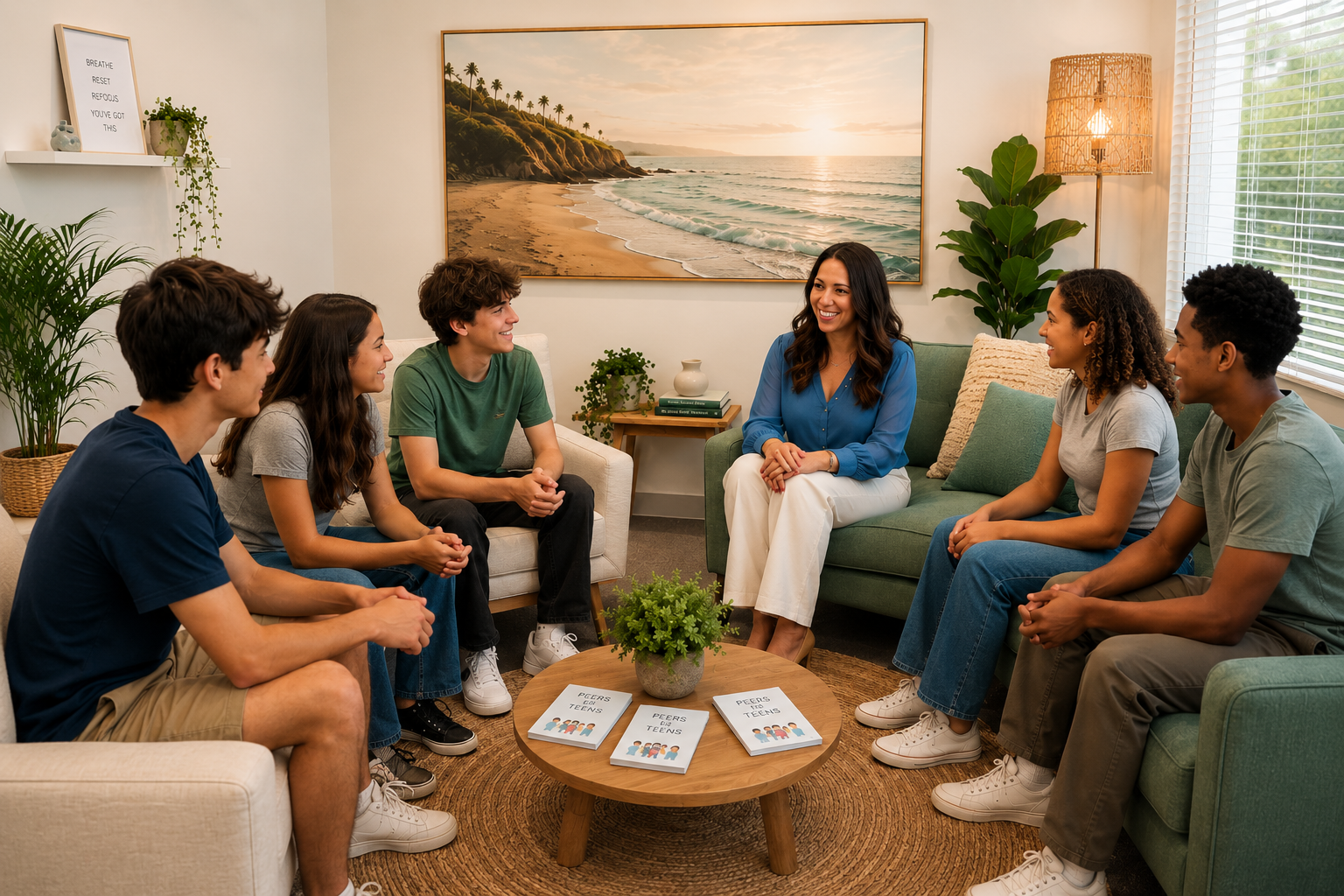
Teens engaging in social activities
EVIDENCE-BASED
REAL-WORLD SKILLS
PARENT- SUPPORTED practice
CONFIDENCE AND CONNECTION

Why This Program Matters

Adolescence is a time of increasing social complexity, where friendships, group dynamics, and social expectations become more nuanced and demanding. For many teens, difficulties in navigating these social environments can impact confidence, increase anxiety, and make it harder to form and maintain meaningful connections.

PEERS® for Adolescents provides a structured and supportive environment where adolescents can learn and practise social skills, with opportunities to apply these skills in everyday situations.

Parent Involvement

Parent and carer involvement is a key part of the PEERS® program. Parents attend weekly sessions where they are introduced to the role of “social coach,” learning how to support and guide their teen’s use of social skills between sessions. This approach supports consistency across home and everyday settings, helping teens practise and apply their skills with ongoing guidance. No prior knowledge is required - our team will guide you through each step.

Program Details

  • Age Range 13–17 years
  • Eligibility Suitable for adolescents experiencing social challenges, including Autism, ADHD, anxiety, and low mood
  • Funding OPTIONS NDIS (Self and Plan-Managed), Medicare and private options available
  • Schedule Saturdays 11:30am - 1:00pm (during school terms)
  • get started Contact our team to learn more, discuss suitability, and secure a place in the next group

Is This the Right Fit?

This program may be a good fit if your teen:

Skills Developed

Participants are introduced to practical social skills across key areas:

Conversation and Friendship Skills

  • Starting and maintaining two-way conversations
  • Identifying shared interests and building connections
  • Entering and exiting conversations appropriately
  • Developing and maintaining friendships

Social Communication and Etiquette

  • Using humour appropriately
  • Communicating effectively online and via text
  • Organising and hosting get-togethers
  • Demonstrating good sportsmanship

Managing Social Challenges

  • Responding to teasing and embarrassing feedback
  • Handling bullying and reputational challenges
  • Managing disagreements and conflict
  • Responding to rumours and gossip

Confidence and Social Resilience

  • Building social confidence
  • Increasing independence in social settings
  • Developing emotional regulation in peer interactions

What Makes This Program Different

  • Internationally recognised program developed at UCLA, informed by ongoing research
  • Structured, step-by-step approach to social skill development
  • Emphasis on real-world application through guided activities and everyday environments
  • Parent and carer involvement to support consistency beyond the group setting
  • Neuroaffirming approach that recognises individual strengths and differences
  • Inclusion of “get-togethers” as part of the program structure to support real-life peer interaction
  • Designed to support a range of social and emotional presentations

What You Can Expect

This program is designed to support adolescents:

  • Practise conversation and social interaction skills
  • Develop insight into friendship dynamics
  • Build confidence navigating social situations
  • Explore communication across in-person and online contexts
  • Increase familiarity with peer interaction in group settings

Program Structure

  • DURATION 10-week program
  • FORMAT Weekly sessions for teens and parents/carers (90 minutes)
  • APPROACH Structured lessons, role-plays, and real-world practice tasks
  • PARENT COMPONENT Parents attend concurrent sessions and and are supported in their role as social coaches
  • PRACTICE BETWEEN SESSIONS Weekly assignments to support the application of skills in everyday settingsn

Research and Evidence

This program draws on a well-established evidence base in adolescent social development. PEERS® for Teens is informed by research including randomised controlled trials and long-term outcome studies exploring social functioning in adolescents. Research in this area has identified:

  • Improvements in social skills, social reciprocity, and communication
  • Increased frequency of peer interactions and social engagement
  • Improved friendship quality and social engagement
  • Increased social awareness, motivation, and responsiveness
  • Reductions in social anxiety and support for emotional regulation

Studies (including Laugeson et al., 2009; 2012) have explored these outcomes over time, with follow-up data suggesting that gains in social functioning may be maintained following program participation.

PEERS® has also been studied across a range of presentations, including Autism, ADHD, anxiety, and broader social-emotional differences. Outcomes may vary depending on individual factors, and participation does not guarantee specific results.

Delivery Options

This program is available through flexible delivery options:

  • FACE-TO-FACE Structured, in-person sessions within a supportive group environment
  • ONLINE (Telehealth) Flexible, accessible sessions with continued parent support
  • SCHOOL-BASED DELIVERY Delivered within school settings to support real-world application and collaboration

Finding the Right Support

We understand that supporting your teen to build friendships and navigate social situations can feel important. Our team is here to guide you through the process, helping you understand your teen’s needs and determine whether PEERS® for Teens is the right fit, or recommend the most appropriate support option.

Ready to explore support options for your teen?

Contact our team to learn more or secure a place in the next PEERS® for Teens group.