
Cool Kids® Anxiety Program | Ages 7–17
When Worry Starts Making the Decisions
Sometimes anxiety looks obvious. Other times it looks like avoiding school, saying no to something your child actually wants to do, asking the same question again and again, needing you close by, becoming distressed when plans change, or worrying about something days before it happens.
When anxiety begins deciding where your child goes, what they try, who they speak to or what they believe they can manage, families can start to feel stuck too.
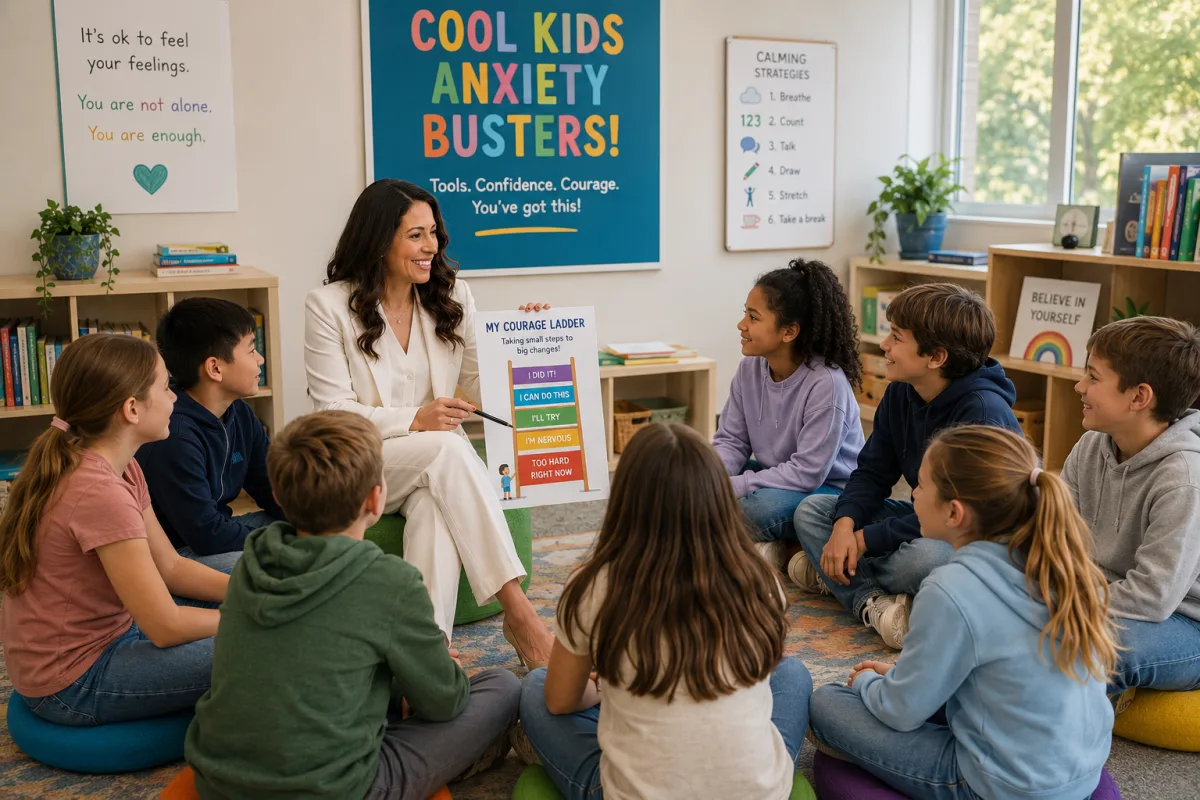
The Cool Kids® Anxiety Program gives children, teenagers and their parents a structured way to understand how anxiety works — and practical CBT-based strategies for gradually responding to fears differently.
The goal is not to tell a worried child to “just be brave.” It is to help them understand anxiety, build practical skills and take manageable steps with support.
- CBT-Based
- Parent-Involved
- Gradual Exposure
- Practical Strategies
When Anxiety Gets in the Way
Anxiety Can Make a Child’s World Smaller
Avoiding something frightening often brings immediate relief. That makes sense. If speaking in class feels terrifying, staying quiet reduces the anxiety. If separating from a parent feels unbearable, staying close feels safer. If attending school feels overwhelming, staying home can bring relief.
The difficulty is that avoidance can also teach the brain: “I escaped it, so it really must have been dangerous.” Over time, anxiety can begin influencing more situations — sometimes including things a child or teenager genuinely wants to be able to do.
Cool Kids® helps young people and their parents understand this cycle and learn ways of approaching fears gradually rather than allowing anxiety to make every decision.
About the Program
Learning How Anxiety Works and What to Do With It
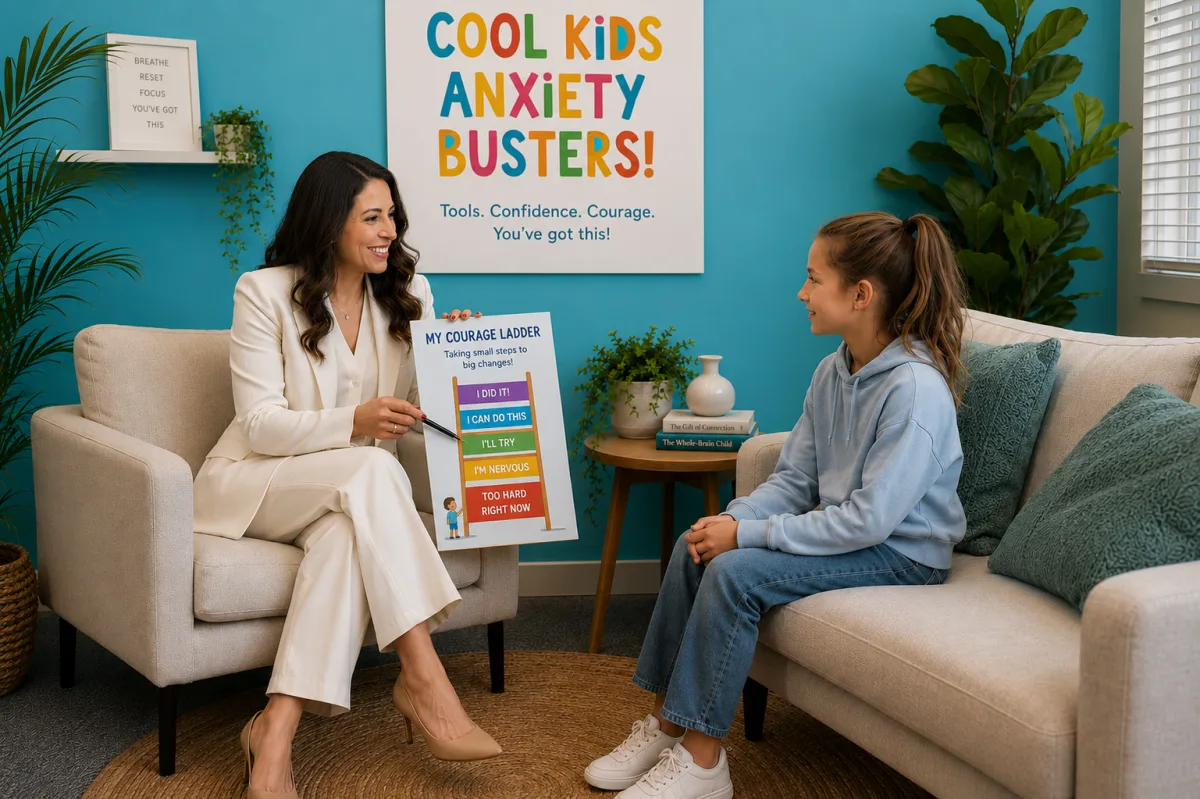
Cool Kids® is a structured cognitive behavioural therapy (CBT) program developed through Macquarie University for children and adolescents experiencing anxiety. The program has been developed for young people aged 7–17 and involves parents or caregivers alongside the child or teenager.
Rather than focusing only on talking about worries, Cool Kids® teaches practical strategies for understanding anxiety and responding to it differently. Participants explore the relationship between thoughts, feelings, body responses and behaviour. They learn ways of recognising anxious thinking, approaching fears gradually, solving problems and developing practical strategies for situations that feel difficult.
Parents are part of the program because anxiety rarely occurs only inside the therapy room. Families learn how to support practice without expecting a child to manage anxiety completely independently. For neurodivergent participants, strategies are applied individually — not every avoidance response is assumed to be anxiety that simply needs to be challenged.
Program Suitability
Could Cool Kids® Be a Good Fit for Your Child or Teen?
Cool Kids® may be worth exploring when anxiety is beginning to interfere with everyday life and a child or teenager may benefit from a structured CBT-based approach with active parent involvement.
Avoiding school, activities, social situations or unfamiliar experiences because of anxiety
Separation anxiety
Social anxiety or fear of judgement
Repeated reassurance-seeking
Physical symptoms associated with anxiety
Worry that feels difficult to manage
Specific fears or phobias
Difficulty coping with uncertainty
Anxiety interfering with participation in everyday life
A family wanting structured strategies they can practise together
Your child does not need to experience every one of these difficulties. An initial consultation helps us understand what is happening, your child’s or teenager’s goals and needs, and whether Cool Kids® and the available group format are likely to be appropriate.
Skills & Practice
Giving Young People a Practical Way to Work With Anxiety
Understanding Anxiety
How anxiety affects thoughts, feelings, body sensations and behaviour
Personal signs of anxiety
Situations that trigger worry
How avoidance can keep anxiety going
Flexible Thinking
Noticing anxious predictions
Looking at the evidence
Considering alternative possibilities
Developing more realistic and flexible ways of thinking about difficult situations
Practical Coping & Problem Solving
Relaxation strategies
Problem solving
Coping strategies
Planning for difficult situations
Ways of responding when worry becomes strong
Facing Fears Gradually
Identifying feared situations
Breaking challenges into manageable steps
Using stepladders / exposure hierarchies
Reflecting on what happened rather than relying only on what anxiety predicted
Parents Learn Too
Because Parents Get Pulled Into the Anxiety Cycle Too
When your child is frightened, helping them feel safe is a natural response. You might answer the same reassurance question again. Let them stay home. Speak for them. Change a plan. Avoid a situation that you know will lead to distress.
Sometimes those responses are exactly what a child needs. At other times, families can find themselves organising more and more of everyday life around anxiety.
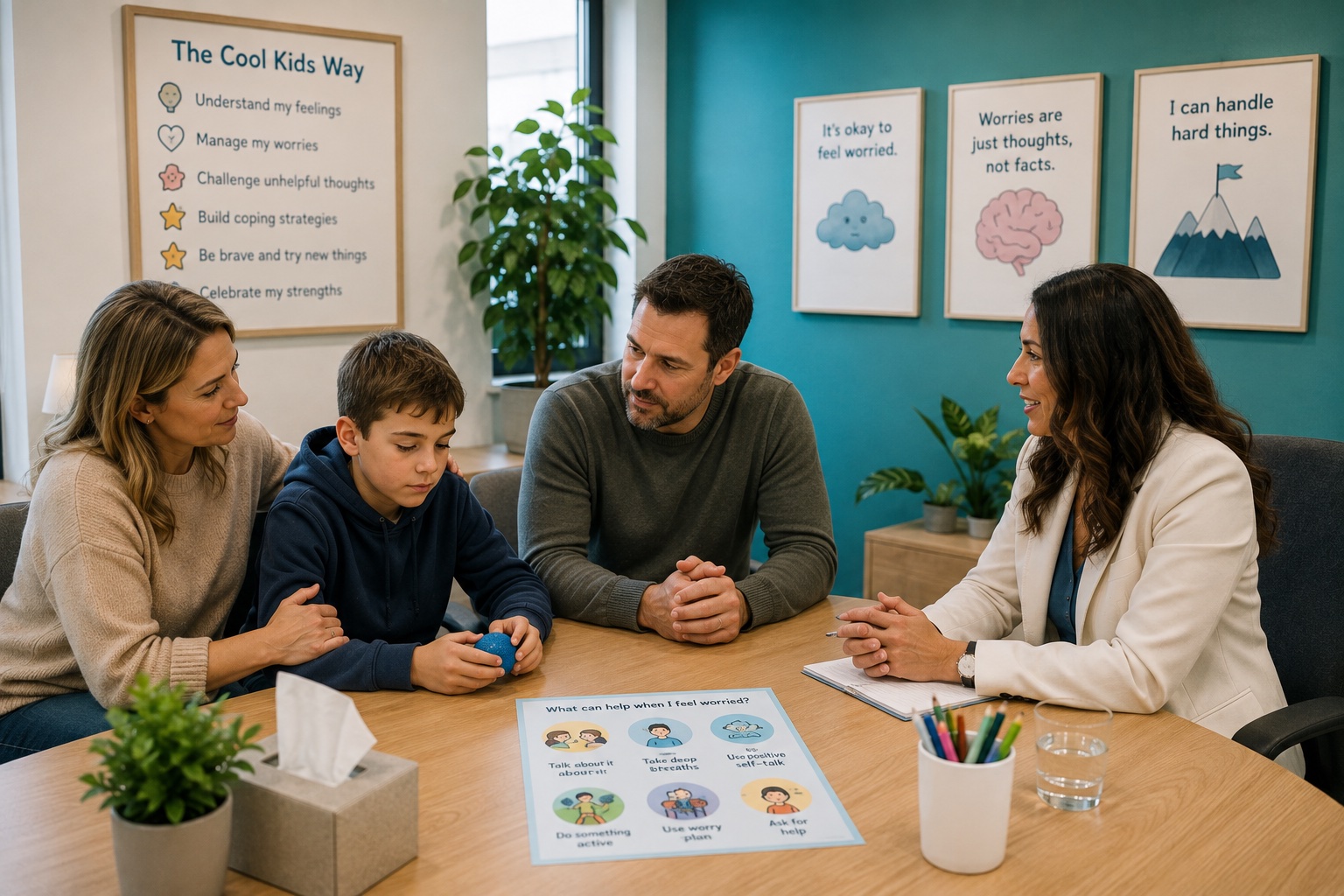
Cool Kids® involves parents because supporting an anxious child is not simply about telling them to worry less or pushing them to face a fear. Parents learn how anxiety works, how to recognise patterns of avoidance and reassurance, how to support gradual practice, how to encourage effort, how to help with problem solving, and when support is useful versus when anxiety may be asking the family to step in unnecessarily.
Parents are responding to distress with the information they have. The program provides additional strategies and choices.
How It Works
Understand It. Plan for It. Practise It.
- 01
Understand
Learn how anxiety operates and identify personal patterns.
- 02
Notice
Recognise anxious thoughts, body responses, avoidance and situations that trigger worry.
- 03
Plan
Use thinking skills, problem solving and stepladders to decide what to practise.
- 04
Practise
Take manageable steps in and between sessions.
- 05
Review
Look at what actually happened, what was learned and what the next step might be.
Why This Program?
What Makes This Program Different
Structured CBT Approach
Cool Kids® provides a structured framework for understanding anxiety and practising evidence-based CBT strategies.
Child + Parent Learning
Parents participate alongside the young person rather than being left outside the learning process.
Gradual Practice
Facing fears is broken into manageable steps rather than expecting a young person to confront their hardest fear immediately.
Real-Life Application
Strategies are practised in situations where anxiety actually occurs.
Developed Through Macquarie University
Cool Kids® has been developed and scientifically evaluated through Macquarie University's anxiety research and clinical programs over several decades.
Research & Evidence
What Does the Research Tell Us?
Cool Kids® has been evaluated over several decades in Australia and internationally, including randomised controlled trials, international adaptations, different delivery formats and follow-up research. Across studies, CBT delivered through Cool Kids® has been associated with reductions in anxiety symptoms and diagnostic recovery for many children and adolescents. Outcomes vary across studies, participants and delivery formats, and not every young person becomes anxiety-disorder free following treatment.
Effects Replicated Outside Australia
A randomised controlled trial involving 109 children and adolescents aged 7–16 compared the Danish Cool Kids® group program with a waitlist condition. At post-treatment, 48.2% of participants receiving Cool Kids® were free of all anxiety diagnoses compared with 5.7% in the waitlist group. Improvements continued to three-month follow-up and were maintained at 12 months. Participants with a primary diagnosis of social phobia showed less improvement than those with other anxiety diagnoses. (Arendt et al., 2016 )
Evidence Across Different Delivery Formats
A randomised controlled trial of 95 children aged 7–12 compared therapist-supported Cool Kids® Online with a waitlist condition. Children receiving Cool Kids® Online showed significantly greater remission of anxiety diagnoses and greater caregiver-reported reductions in anxiety symptoms and interference at the end of treatment. Child-reported outcomes and some secondary outcomes did not differ significantly between conditions. (McLellan et al., 2024 )
A Program Studied Over Time
Macquarie University's Centre for Emotional Health reports that around 60% of young people who complete the standard program no longer meet criteria for their original anxiety diagnosis immediately following treatment, rising to around 75% in the months that follow. These figures describe the broader Cool Kids® program as evaluated and reported by its developers, rather than one single trial. (Macquarie University, Centre for Emotional Health )
Important Context
Research findings describe outcomes observed across groups of participants and cannot predict how an individual child or teenager will respond. Cool Kids® has a substantial research base, but outcomes vary according to the participant, anxiety presentation, delivery format and other individual factors. The Social Space's 10-week, 90-minute group format is not identical to every protocol used in published Cool Kids® trials. Participation does not guarantee that anxiety symptoms or diagnoses will resolve, and program suitability is considered individually.
Delivery
Flexible Ways to Participate
Mascot Clinic
Structured group delivery at The Social Space.
Online / Telehealth
Online delivery may be available depending on the program format and current offering.
School-Based Delivery
Cool Kids® may also be considered for school delivery through The Social Space's School & Community Programs, with delivery adapted to the school context while maintaining the core program approach where possible.
Current delivery options can be discussed during the initial consultation.
Want to Learn More About the Cool Kids® Anxiety Program?
Our team can learn more about what your child or teenager is experiencing, answer your questions and discuss whether Cool Kids® and the available group format may be a suitable next step.