
Many parents come to therapy asking a similar question:
“My child is bright, funny, and kind… so why are friendships so hard?”
Often, the answer lies in understanding the underlying differences in how children experience and navigate the social world.
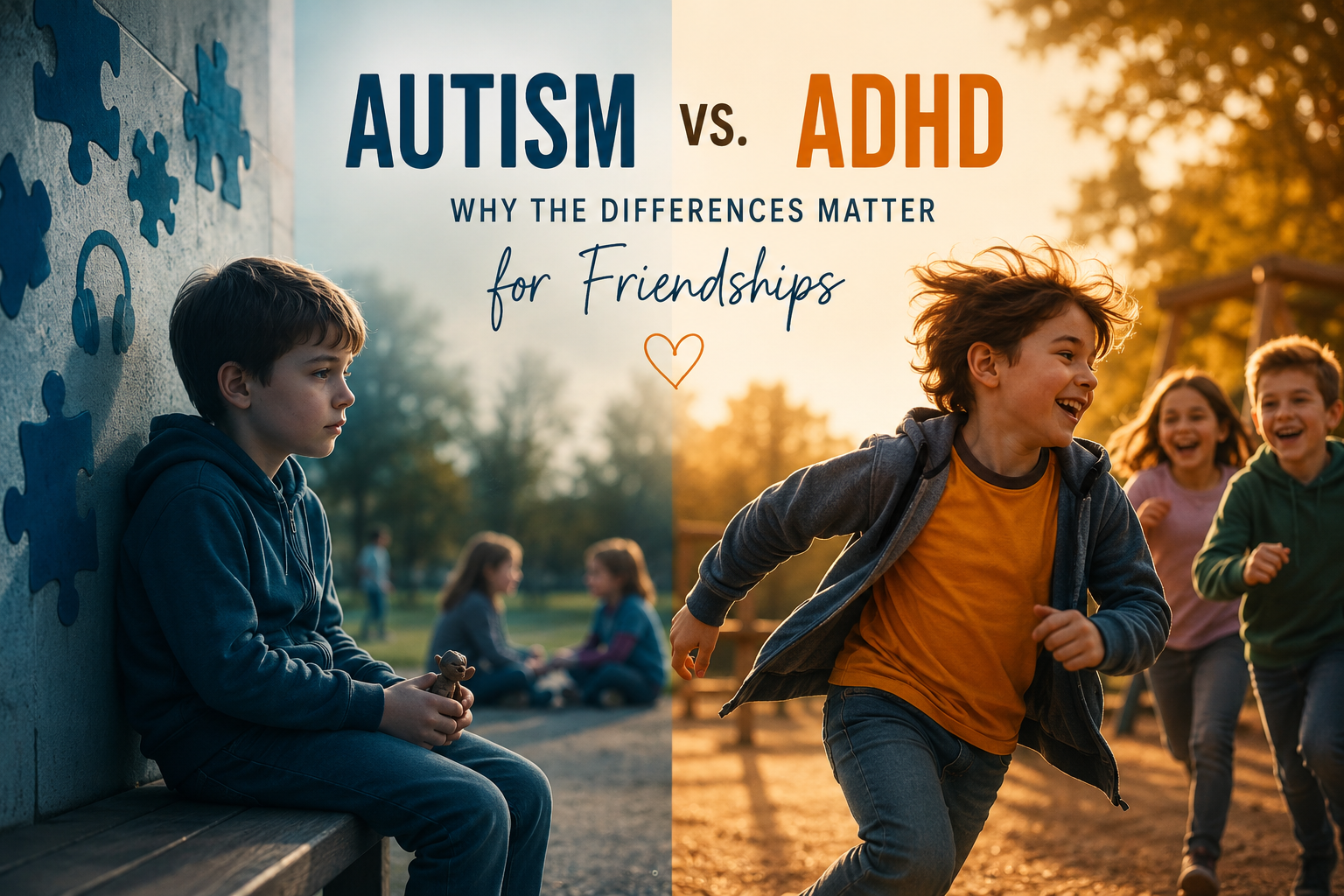
For many young people, social challenges can relate to ADHD, autism, or sometimes both. While these conditions can look similar from the outside, especially when it comes to friendships, the reasons behind the difficulties can be quite different.
Understanding these differences helps parents, teachers, and clinicians choose the right strategies and supports to help children build meaningful social connections.
Friendship skills are not simply personality traits.
They are skills that can be learned and practised.
ADHD and Social Challenges
Children with ADHD often have a strong desire for friendships. They are frequently energetic, enthusiastic, and eager to engage with others. However, certain ADHD traits can make social situations challenging.
Some of the most common social difficulties linked to ADHD include:
Impulsivity
Children with ADHD may speak or act before thinking. This can lead to behaviours such as:
- interrupting conversations
- blurting out comments
- changing the topic abruptly
- invading personal space
While these behaviours are not intentional, peers may sometimes interpret them as rude or disruptive.
Emotional Intensity
Many children with ADHD experience emotions very strongly. Excitement, frustration, or disappointment can feel overwhelming and may lead to:
- big emotional reactions during games
- difficulty losing or sharing
- sudden frustration with friends
Peers may struggle to understand these reactions, which can lead to conflict.
Difficulty Waiting or Taking Turns
Group interactions require subtle timing. Children with ADHD may struggle with:
- waiting for their turn to speak
- listening fully to others
- staying focused during conversations
Over time, these patterns can make it harder for friendships to develop naturally.
Autism and Social Challenges
Autistic children often experience social situations differently. Many autistic children deeply want friendships but may find the unwritten rules of social interaction confusing or unpredictable.
Some common social challenges associated with autism include:
Difficulty Reading Social Cues
Friendships rely heavily on subtle communication signals, such as:
- facial expressions
- tone of voice
- body language
- sarcasm or humour
Autistic children may find these cues difficult to interpret, which can lead to misunderstandings.
Social Confusion
Many social rules are never explicitly taught. For example:
- how to enter a group conversation
- how long to talk about a favourite topic
- how to recognise when someone is bored
Without clear guidance, these interactions can feel confusing or overwhelming.
Literal Thinking
Autistic individuals often interpret language literally. This can make it harder to understand:
- jokes
- sarcasm
- teasing
- indirect communication
When others assume shared understanding of these social nuances, autistic children may feel left out or misunderstood.
Where ADHD and Autism Overlap
Although ADHD and autism have distinct characteristics, they also share several overlapping social experiences.
Many children with either condition experience:
Rejection Sensitivity
Repeated social misunderstandings or conflicts can lead children to become highly sensitive to rejection.
Even small social setbacks may feel very painful.
Anxiety
Social environments such as school playgrounds or group activities can feel unpredictable and stressful. This can lead to:
- avoidance of social situations
- increased worry about friendships
- low confidence in social interactions
Friendship Challenges
Both ADHD and autistic children may struggle with:
- maintaining friendships
- resolving conflicts
- understanding peer expectations
Without support, these challenges can affect self-esteem and increase feelings of isolation.
Why Understanding the Differences Matters
Although ADHD and autism can appear similar in social situations, the underlying reasons for the difficulties are different.
This matters because effective support must match the child’s needs.
For example:
- A child with ADHD may benefit from learning impulse control and emotional regulation skills.
- An autistic child may benefit from learning explicit social rules and strategies for interpreting cues.
When children receive targeted support, they often experience significant improvements in confidence and social success.
Why Structured Social Skills Programs Help
One of the most effective ways to support children who struggle socially is through structured social skills programs.
Unlike informal playgroups or unstructured therapy, evidence-based programs explicitly teach:
- how to start and maintain conversations
- how to join group activities
- how to handle teasing or rejection
- how to read social cues
- how to build and maintain friendships
Children practise these skills in a safe and supportive environment, where they receive guidance, feedback, and encouragement.
Importantly, these programs focus not only on skills, but also on building confidence, resilience, and a sense of belonging.
Supporting Social Confidence
At The Social Space Psychology Clinic, we offer structured, evidence-based social skills programs designed to help young people build meaningful connections.
Our PEERS® for Teens program supports adolescents to develop practical friendship skills, including:
- starting conversations
- handling awkward moments
- understanding humour and teasing
- resolving conflict with peers
- developing stronger social confidence
With the right guidance and opportunities to practise, many young people discover that friendships become easier, more enjoyable, and more rewarding.
Final Thoughts
If your child struggles socially, it is important to remember that this is not a reflection of their intelligence, personality, or potential.
Often, they simply need the opportunity to learn and practise skills that many children acquire naturally.
With the right support, children can develop the tools they need to navigate friendships and build lasting connections.