
Chilled — Anxiety Program for Teens | Ages 12–17
When Anxiety Starts Deciding What’s Off the Table
Sometimes anxiety looks obvious. Other times it looks like turning down an invitation they actually wanted, not putting their hand up, avoiding a class or a subject, needing constant reassurance that something will be fine, going quiet, or spending days worrying about something before it happens.
When anxiety begins deciding where a young person goes, what they try, who they speak to or what they believe they can manage, the list of things that feel possible can quietly get shorter — often at exactly the age they are meant to be getting more independent.
Chilled is the teenage version of the Cool Kids® Anxiety Program. It gives young people and their parents a structured way to understand how anxiety works — and practical CBT-based strategies for gradually responding to fears differently.
The goal is not to tell an anxious teenager to “just push through it.” It is to explain how anxiety actually works, give them practical strategies they can use themselves, and take manageable steps with support.
Register Your Interest Book a Free Consultation
Chilled is not currently running. You are welcome to register your interest and we will be in touch when a group is being planned.
- CBT-Based
- Parent-Involved
- Gradual Exposure
- Practical Strategies
When Anxiety Gets in the Way
Anxiety Can Make a Teenager’s World Smaller
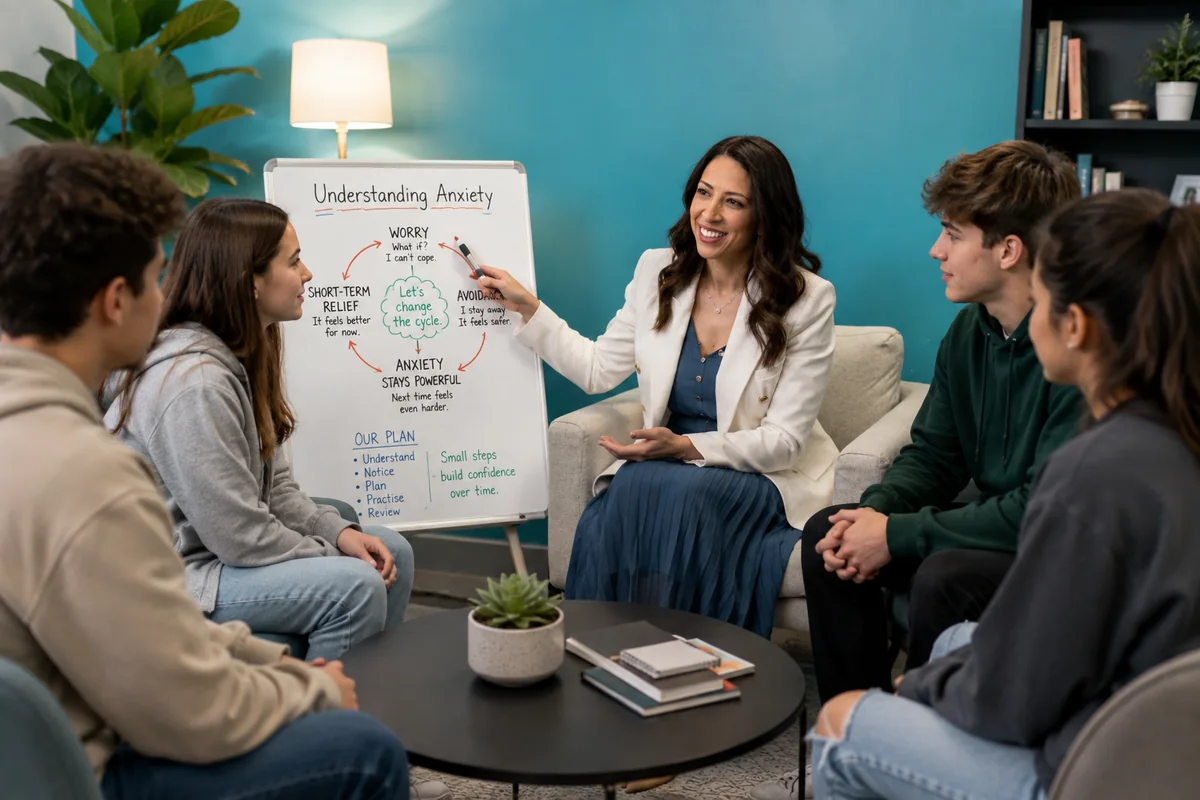
Avoiding something frightening often brings immediate relief. That makes sense. If presenting to the class feels terrifying, staying quiet reduces the anxiety. If a social situation feels unbearable, saying no feels safer. If school feels overwhelming, staying home can bring relief.
The difficulty is that avoidance can also teach the brain: “I escaped it, so it really must have been dangerous.” Over time, anxiety can begin influencing more situations — sometimes including things the young person genuinely wants to be able to do.
Chilled helps young people and their parents understand this cycle and learn ways of approaching fears gradually rather than allowing anxiety to make every decision.
About the Program
Learning How Anxiety Works and What to Do With It
Cool Kids® is a structured cognitive behavioural therapy (CBT) program developed through Macquarie University for children and adolescents experiencing anxiety. The program has been developed for young people aged 7–17 and involves parents or caregivers alongside the young person.
Chilled is Macquarie’s adolescent version of Cool Kids® — the same CBT framework and the same core strategies, with examples, language and material pitched at teenagers rather than young children. This page covers Chilled, for ages 12–17. Children aged 7–12 do Cool Kids®. Where a young person sits near the boundary, placement is discussed at the initial consultation and takes developmental stage into account as well as age.
Rather than focusing only on talking about worries, Chilled teaches practical strategies for understanding anxiety and responding to it differently. Participants explore the relationship between thoughts, feelings, body responses and behaviour. They learn ways of recognising anxious thinking, approaching fears gradually, solving problems and developing practical strategies for situations that feel difficult.
Parents are part of the program because anxiety rarely occurs only inside the therapy room — and because a teenager working on anxiety usually still needs the adults around them to understand what they are trying to do. The balance deliberately shifts with age: young people take more of the lead, and parents support rather than direct. For autistic and otherwise neurodivergent participants, strategies are applied individually — not every avoidance response is assumed to be anxiety that simply needs to be challenged.
Choosing a Version
Standard Program or Autism-Adapted Version?
Chilled can be delivered using the standard program materials or, for autistic young people where it is appropriate, the Autism Spectrum Adaptation. Both are anxiety programs built on the same CBT framework and the same core strategies — understanding anxiety, more realistic thinking, facing fears gradually through stepladders, coping and problem solving, parent involvement and practice between sessions.
Standard Chilled
Uses the standard Chilled materials and CBT framework developed through Macquarie University.
Chilled Autism Spectrum Adaptation
The same core anxiety framework, with the way concepts are presented and the examples used adjusted to reflect learning styles and everyday experiences that are common among autistic teenagers.
Neither version is the better program — they suit different people. Being autistic does not automatically mean the adapted version is the right fit, and our team can discuss which is likely to suit a young person before the program starts. In both versions, an avoidance response is not assumed to be anxiety that simply needs to be challenged; sometimes it reflects a genuine sensory, communication or environmental need, and that distinction matters.
Program Suitability
Could Chilled Be a Good Fit for Your Teenager?
Chilled may be worth exploring when anxiety is beginning to interfere with everyday life, and where a structured CBT-based approach with active parent involvement may be appropriate.
Avoiding school, activities, social situations or unfamiliar experiences because of anxiety
Separation anxiety
Social anxiety or fear of judgement
Repeated reassurance-seeking
Physical symptoms associated with anxiety
Worry that feels difficult to manage
Specific fears or phobias
Difficulty coping with uncertainty
Anxiety interfering with participation in everyday life
A family wanting structured strategies they can practise together
A young person does not need to experience every one of these difficulties. An initial consultation helps us understand what is happening, their goals and needs, and whether Chilled and the available group format are likely to be appropriate.
Skills & Practice
Giving Young People a Practical Way to Work With Anxiety
Understanding Anxiety
How anxiety affects thoughts, feelings, body sensations and behaviour
Personal signs of anxiety
Situations that trigger worry
How avoidance can keep anxiety going
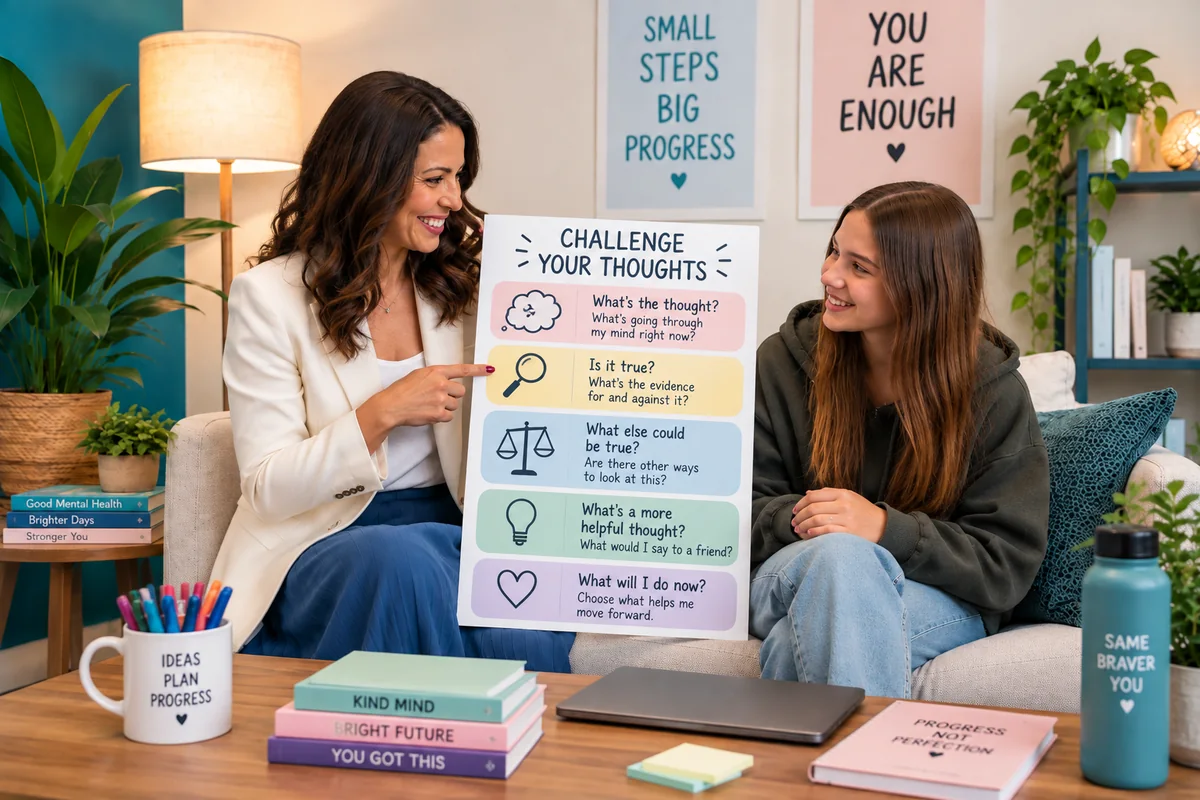
Flexible Thinking
Noticing anxious predictions
Looking at the evidence
Considering alternative possibilities
Developing more realistic and flexible ways of thinking about difficult situations
Practical Coping & Problem Solving
Relaxation strategies
Problem solving
Coping strategies
Planning for difficult situations
Ways of responding when worry becomes strong
Facing Fears Gradually
Identifying feared situations
Breaking challenges into manageable steps
Using stepladders / exposure hierarchies
Reflecting on what happened rather than relying only on what anxiety predicted
Parents Learn Too
Because Parents Get Pulled Into the Anxiety Cycle Too
When your teenager is anxious, helping them feel safe is a natural response. You might answer the same reassurance question again. Let them skip the day. Make the phone call for them. Change a plan. Avoid a situation you know will lead to distress.
Sometimes those responses are exactly what a young person needs. At other times, families can find themselves organising more and more of everyday life around anxiety — often without anyone deciding to.
Chilled involves parents because supporting an anxious teenager is not simply about telling them to worry less or pushing them to face a fear. Parents learn how anxiety works, how to recognise patterns of avoidance and reassurance, how to support gradual practice, how to encourage effort, how to help with problem solving, and when support is useful versus when anxiety may be asking the family to step in unnecessarily — while leaving room for a young person to take the lead on their own goals.
Parents are responding to distress with the information they have. The program provides additional strategies and choices.

How It Works
Understand It. Plan for It. Practise It.
- 01
Understand
Learn how anxiety operates and identify personal patterns.
- 02
Notice
Recognise anxious thoughts, body responses, avoidance and situations that trigger worry.
- 03
Plan
Use thinking skills, problem solving and stepladders to decide what to practise.
- 04
Practise
Take manageable steps in and between sessions.
- 05
Review
Look at what actually happened, what was learned and what the next step might be.
Why This Program?
What Makes This Program Different
Structured CBT Approach
Chilled provides a structured framework for understanding anxiety and practising evidence-based CBT strategies.
Teen + Parent Learning
Parents participate alongside the young person rather than being left outside the learning process.
Gradual Practice
Facing fears is broken into manageable steps rather than expecting a young person to confront their hardest fear immediately.
Real-Life Application
Strategies are practised in situations where anxiety actually occurs.
Developed Through Macquarie University
Cool Kids® has been developed and scientifically evaluated through Macquarie University's anxiety research and clinical programs over several decades.
Research & Evidence
What Does the Research Tell Us?
Chilled is the adolescent program within the Cool Kids® suite, which has been evaluated over several decades in Australia and internationally, including randomised controlled trials, international adaptations, different delivery formats and follow-up research. Across studies, CBT delivered through Cool Kids® has been associated with reductions in anxiety symptoms and diagnostic recovery for many children and adolescents. Outcomes vary across studies, participants and delivery formats, and not every young person becomes anxiety-disorder free following treatment. The research below is drawn from the Cool Kids® suite; where a study covers a particular age range, that range is stated.
Effects Replicated Outside Australia
A randomised controlled trial involving 109 children and adolescents aged 7–16 — an age range that covers most of the Chilled group — compared the Danish Cool Kids® group program with a waitlist condition. At post-treatment, 48.2% of participants receiving Cool Kids® were free of all anxiety diagnoses compared with 5.7% in the waitlist group. Improvements continued to three-month follow-up and were maintained at 12 months. Participants with a primary diagnosis of social phobia showed less improvement than those with other anxiety diagnoses. (Arendt et al., 2016 )
A Program Studied Over Time
Macquarie University reports that approximately 60 to 75 per cent of children who complete Cool Kids® are free of their anxiety disorder after treatment. This figure describes the broader Cool Kids® suite as evaluated and reported by its developers over three decades, rather than the result of any one trial or of the adolescent program specifically, and it describes those who complete the program. (Macquarie University, Emotional Health Clinic )
Important Context
Research findings describe outcomes observed across groups of participants and cannot predict how an individual young person will respond. The Cool Kids® suite has a substantial research base, but outcomes vary according to the participant, anxiety presentation, delivery format and other individual factors. The Social Space's 10-week, 90-minute group format is not identical to every protocol used in published Cool Kids® trials, and the Autism Spectrum Adaptation is not the version evaluated in the studies cited above. Participation does not guarantee that anxiety symptoms or diagnoses will resolve, and program suitability is considered individually.
Flexible Delivery
Where This Program Can Be Delivered
Mascot Clinic
Structured group delivery at The Social Space.
Online / Telehealth
Online delivery may be available depending on the program format and current offering.
School-Based Delivery
Chilled can also be delivered in secondary schools. How it runs in a school — timetabling, the room, staff involvement and how parent participation is planned — is set out on the school page.
Current delivery options can be discussed during the initial consultation.
For Schools
Looking for Chilled for Your School?
We deliver Chilled in secondary schools. The school page sets out how it runs in a school setting, including how parent participation is planned around the school day.
Want to Learn More About Chilled?
Our team can learn more about what your teenager is experiencing, answer your questions and discuss whether Chilled, and which version of it, may be a suitable next step.